
The short answer
A lock works like an elevator for boats. You contact the lock operator, wait for the green light, idle into the chamber and tie to a floating post while the water rises or falls to match the next lake. The Tennessee Valley Authority (TVA) says locking through is free and usually takes 45 minutes to an hour. Watts Bar Lake, home to Tennessee National in Loudon, Tennessee, has a lock at each end.
Key facts
- The Tennessee Valley Authority (TVA) says nine main and four auxiliary locks on the Tennessee River let commercial and recreational vessels pass between reservoirs.
- TVA says locking through is a free service, with facilities provided by TVA and operated by the U.S. Army Corps of Engineers.
- TVA says the process usually takes 45 minutes to an hour, and may take longer when commercial traffic is heavy.
- TVA says the locks are filled and emptied by gravity. No pumps are used.
- Watts Bar Lake has a lock at each end, at Fort Loudoun Dam and at Watts Bar Dam. TVA lists each lock at 60 by 360 feet, with a lift of roughly 70 feet.
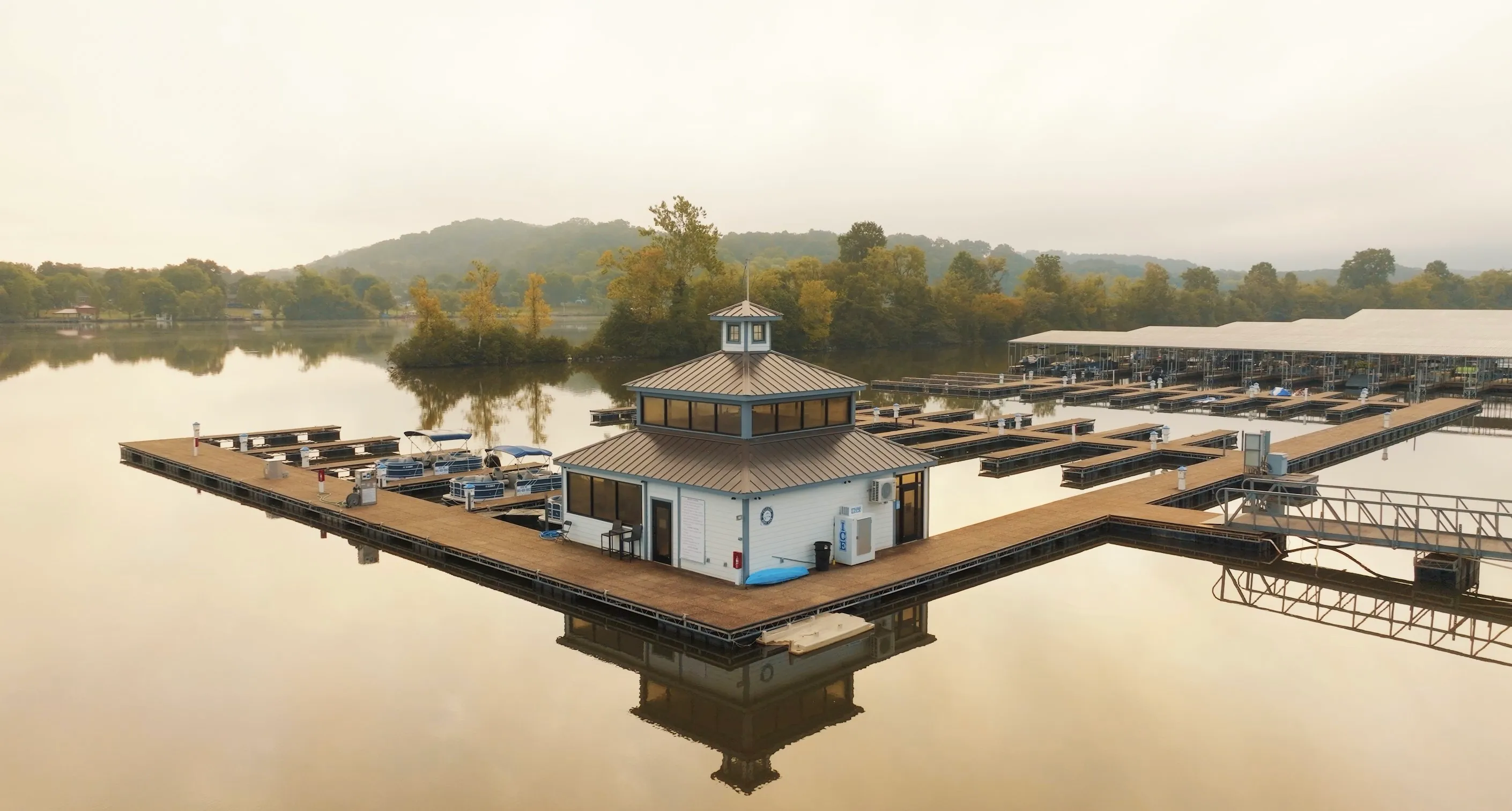
- Tennessee National is a private, gated lake and golf community on Watts Bar Lake in Loudon, Tennessee, with a full-service marina and 140+ boat slips.
A lock works like an elevator for boats. You contact the lock operator, idle into a chamber, tie to a floating post and ride the water up or down to the next lake. The Tennessee Valley Authority (TVA) says locking through is free and usually takes 45 minutes to an hour.
This page covers the lock itself: what it is, how you ask to go through, what to do inside and how much of the day it takes. Tennessee National, a private, gated lake and golf community in Loudon, Tennessee, is on Watts Bar Lake, which has a lock at each end. For where those locks lead, see Can you boat from Tennessee National to Knoxville?.
What is a lock, and how does it move a boat?
A lock is a chamber at a dam, with gates at both ends, that raises or lowers a boat from one lake level to the next. TVA says the locks work "much like an elevator."
The Tennessee River is a chain of lakes, each one held higher than the next by a dam. TVA says nine main and four auxiliary locks on the river make it possible for commercial and recreational vessels to pass between reservoirs.
No machine lifts the boat. The water does. TVA says the locks are filled and emptied by gravity, and no pumps are used.
| Direction | What the lock does, by TVA's account | What your boat does |
|---|---|---|
| Downstream | The gates close. The downstream valves open and the water drains out of the chamber. | Goes down to the level of the lake below. |
| Upstream | The gates close. The downstream valves close, the upstream valves open and water flows in from above. | Rises to the level of the lake above. |
When the water in the chamber matches the next lake, the gates at the far end open and you idle out.
Two agencies share the work. TVA says it operates the dams and the U.S. Army Corps of Engineers operates the navigation locks. So a question about a lock goes to the Corps.
Which locks are on Watts Bar Lake?
Two on the Tennessee River, one at each end of the lake, and a third on the Clinch River.
| Lock | Where it is | What is on the other side | What TVA says about it |
|---|---|---|---|
| Fort Loudoun | Fort Loudoun Dam at Lenoir City, the upper end of the lake | Fort Loudoun Lake, toward Knoxville | A 60 by 360 foot lock that "raises and lowers rivercraft about 70 feet." |
| Watts Bar | Watts Bar Dam near Spring City, the lower end of the lake | Chickamauga Lake, toward Chattanooga | A 60 by 360 foot lock that "lifts and lowers barges as much as 70 feet." |
| Melton Hill | Melton Hill Dam on the Clinch River, which runs into Watts Bar Lake | Melton Hill Lake | A 75 by 400 foot chamber with a maximum lift of 60 feet. TVA says to contact the lock to schedule a lockage. |
Seventy feet is the number to picture. That is about how far the water under your boat can move in one trip through either river lock.
Tennessee National is in Loudon, toward the upper end of the lake, so Fort Loudoun is the closer of the two river locks. Where is Watts Bar Lake? has the full map in words.
How do you tell the lock you want to go through?
You contact the lock operator when you arrive. TVA's Locking Through page lists three ways.
- Marine radio. Use channel 16 to tell the lock operator who you are and what you intend to do.
- Phone. Call the lock operator from a mobile phone. Get the current number from TVA or the Corps before you leave the dock.
- Signal cord. Pull the small-craft signal cord. TVA says it is in the ladder recess near the end of the upper and lower approach walls.
TVA says the lock operator then tells you how to proceed, by radio, phone or loudspeaker. After that, watch the lights and listen for the horn.
| Signal | What TVA says it means |
|---|---|
| Red flashing light | The lock is not available. |
| Amber flashing light | The lock is being made ready. You may approach the guide wall, but do not enter the chamber. |
| Green flashing light | The lock is ready and you may enter the chamber. |
| One long horn blast | Enter the lock. |
| One short horn blast | Exit the lock. |
On the approach, TVA says to stay in the navigation channel marked by the buoys and to follow the posted safety regulations.
What do you do inside the lock chamber?
Tie to a floating post, shut the engine down, stay seated and keep life jackets on. TVA's instructions run in this order.
- Come in slowly. Enter the lock at no-wake speed.
- Tie to a floating mooring post. The post rides up or down the wall with the water, so your line moves with the boat. TVA says not to tie to a ladder or any other fixed structure in the lock.
- Use fenders. TVA says they prevent damage from scraping the lock wall or another boat.
- Shut the engines down. TVA says passengers should stay seated and everyone aboard should wear a personal flotation device during the entire process.
- Share the wall. In a crowded chamber, TVA says, you may be asked to tie off another boat.
- Wait for the signal to leave. Stay tied up until the lockage is complete, the gate is fully open and the lock operator signals you out. Leave at no-wake speed and do not pass other boats on the way out.
TVA says every boat entering a lock should have at least 50 feet of rope or line for the mooring post. Bring fenders too, and read TVA's Locking Through page before a first trip.
How long does a lock take, and what does it cost?
It costs nothing, and TVA says it usually takes 45 minutes to an hour.
- The fee. There is none. TVA says all locks on the Tennessee River are available for use without charge.
- The time. Usually 45 minutes to an hour, by TVA's account. It may take longer when commercial traffic is heavy.
- Who goes first. This is a working river. TVA's Information for Boaters page says commercial traffic gets priority, and that "every third boat through is a recreational user."
- The round trip. Up and back is two lockages. At TVA's usual pace that is an hour and a half to two hours at the lock, before any wait for commercial traffic.
- The hours. Locks keep hours, and they are not the same at every lock. TVA's How the Navigation System Works page lists some locks as open around the clock and others on a shorter day. Do not assume the lock you need runs all night.
Who do you ask before a lock trip?
Ask the Corps about the lock and TVA about the water.
| Question | Who to ask |
|---|---|
| Is the lock open today, and what are its hours? | The U.S. Army Corps of Engineers, which operates the lock. TVA names the Corps' Nashville District. |
| What is the lake level, and how is the river flowing? | TVA, which manages both. See Watts Bar Lake levels. |
| What are the state boating rules, and who needs the boating safety certificate? | The Tennessee Wildlife Resources Agency (TWRA). See Do you need a boating license in Tennessee?. |
| Where does a boat stay at Tennessee National? | The marina, a full-service marina with 140+ boat slips on Watts Bar Lake. |
The honest part
- A lock is slow, and tows come first. Figure about an hour each way, plus any wait behind commercial traffic. TVA does not say how long that wait can run.
- The water near a dam deserves respect. TVA's words: "Be aware that some areas near locks can be dangerous."
- A lock can be out of service. This page cannot tell you whether a lock is open this week. The Corps can.
- Small craft are a question to ask. TVA's page does not say whether a kayak or a personal watercraft can lock through. Ask the lock operator first.
- Most days you will not need a lock. Watts Bar Lake is more than 39,000 acres of water and 722 miles of shoreline on its own.
Frequently asked questions
Does it cost money to go through a lock on the Tennessee River?
No. The Tennessee Valley Authority (TVA) says all locks on the Tennessee River are available for use without charge. TVA describes locking through as a free service, with facilities provided by TVA and operated by the U.S. Army Corps of Engineers.
How long does it take to go through a lock on the Tennessee River?
The Tennessee Valley Authority (TVA) says going through a Tennessee River lock usually takes 45 minutes to an hour, and may take longer when commercial traffic is heavy. TVA says commercial traffic gets priority and that every third boat through is a recreational user. A round trip through one lock means two lockages.
How do you signal a lock operator on the Tennessee River?
The Tennessee Valley Authority (TVA) lists three ways to reach a Tennessee River lock operator: marine radio channel 16, a mobile phone call to the lock, or the small-craft signal cord in the ladder recess near the end of the approach wall. The lock operator then gives instructions by radio, phone or loudspeaker.
Which locks are on Watts Bar Lake?
Watts Bar Lake has a lock at each end on the Tennessee River. The lock at Fort Loudoun Dam, in Lenoir City, leads upstream toward Knoxville. The lock at Watts Bar Dam, near Spring City, leads downstream toward Chattanooga. A third lock, at Melton Hill Dam, is on the Clinch River. Tennessee National, in Loudon, is closer to the Fort Loudoun lock.
Do you have to wear a life jacket in a lock?
The Tennessee Valley Authority (TVA) says everyone aboard a boat should wear a personal flotation device during the entire locking process. TVA also says engines should be shut down during the lockage, passengers should remain seated, and the boat should be tied to a floating mooring post, not to a ladder.
Facts about Tennessee National come from the community. Lake facts come from TVA. Rules, taxes, loans and insurance change, so confirm anything that affects a purchase with the right office or professional before you buy.