
The short answer
Judge the course the way you would use it. See it from the tees you would play, look closely at the turf, ask the club how busy the tee sheet gets and how membership works, then make the trip from a homesite to the first tee. At Tennessee National, on Watts Bar Lake in Loudon, Tennessee, the course to evaluate is a Greg Norman Signature design of 18 holes, 7,393 yards and par 72.
Key facts
- Tennessee National has one Greg Norman Signature golf course: 18 holes, 7,393 yards, par 72.
- Tennessee National is a golf cart community on 1,492 gated acres on Watts Bar Lake.
- East Tennessee has four seasons and mild winters.
- Tee time, guest and golf membership questions go to the club.
- Tennessee National is about 30 minutes from Knoxville.
Most people visit a golf community the way they visit a house for sale. They see the clubhouse, a model home and the view from a homesite. The course gets a drive-by and a nod.
If golf is part of why you are buying, that is backwards. The course is the amenity you will use most, and the one you cannot change later.
Here is how to look at it properly. The example is Tennessee National, a private, gated lake and golf community on Watts Bar Lake in Loudon, Tennessee, with one Greg Norman Signature course.
Should you play the course before you buy?
Yes, if you can. If you cannot, ride or walk several holes.
Ask the club before your visit whether you can play or ride the course. Visitor play is the club's decision, so settle it ahead of time and not at the gate.
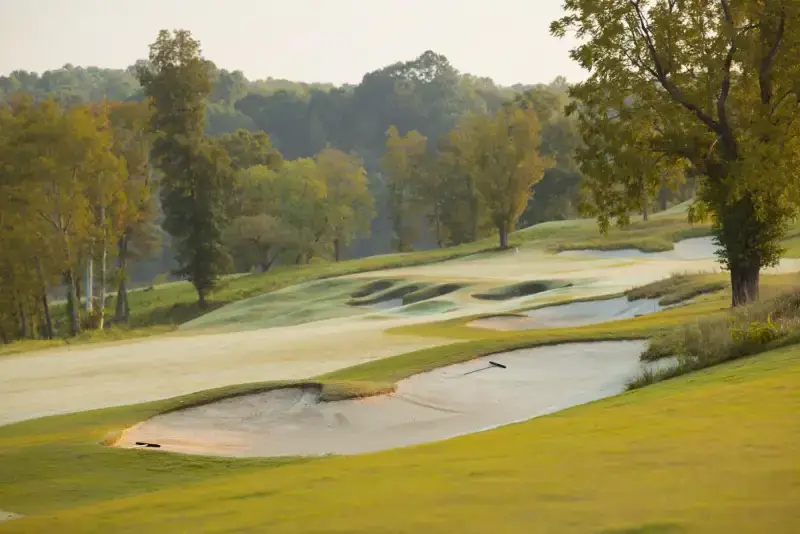
A course looks different from the tee than it does from the road. You want to know how it plays for your game, not how it photographs.
See it from the tees you would use week to week. The Tennessee National course is 7,393 yards at full length, with a par of 72. Almost nobody should judge it from all the way back. Ask the club which tees the course has, and stand on the ones that fit you.
What should a well-designed course show you?
Variety and choices. Those two things keep a course interesting after a hundred rounds.
- Different holes. Do the par fours ask different questions, or is it the same hole again and again? Do the par threes play to different lengths and in different directions?
- Use of the land. Good holes follow the ground. They do not fight it.
- Options off the tee. A good hole gives the bold player and the careful player two routes to the same green. Notice whether you had a choice.
- Interesting greens. Look at how each green is shaped and guarded. Flat, similar greens get dull.
A designer's name is a clue, not a verdict. What a Greg Norman Signature golf course is explains what the label does and does not tell you.
How do you judge the condition of a course?
Look past the day you visit. Every course is dressed up for company.
- Tees. Level, with healthy turf, not worn to dirt.
- Bunkers. Clean edges and sand that is the same from one bunker to the next.
- Greens. Look at the edges and the approaches, not only the putting surface.
- Drainage. If it rained yesterday, where is the water sitting today?
- The far corners. Check a hole that is not on the way to the clubhouse.
Ask when the greens were last aerated. Sandy, bumpy greens for a week or two afterward are normal. How golf course maintenance affects fairway homes explains the yearly cycle.
Then ask the question visitors rarely ask. What work has been done on the course in the last few years, and what is planned? Irrigation, drainage and bunker work are the costly items. A club that is doing them takes the course seriously.
What should you ask about tee times and pace?
Ask how hard it is to get on the course when you would want to play. A good course you cannot get on is not much use.
These are questions for the club:
- How far ahead are tee times booked?
- How hard is a Saturday morning in the busy season?
- How long does a weekend round take?
- Who can play? Members only, guests of members, or outside play as well?
- What does membership cost, and what does it include?
Get the answers in writing. This post does not have them, and a blog should not guess at a club's rules.
How does the course connect to the homes?
Ride it and find out. Tennessee National is a golf cart community, so the trip from a home to the first tee is part of the golf.
Start at a homesite you like. Ask to ride from there to the first tee, then on to the clubhouse and the marina, on whatever routes are open to carts. That ride is your commute. If it feels like something you would do on a whim on a Tuesday, the course will get used.
If the home you like sits beside the course, look at three more things. Where do tee shots land? Where do carts pass? When do the mowers come through? The pros and cons of living on a golf course covers each one.
What does the checklist look like?
Seven checks, and each one fits into a single visit.
| What to check | How to check it | A good sign |
|---|---|---|
| Fit for your game | See several holes from your tees | You have a shot you can hit on every tee |
| Variety | Compare the par threes and the par fours | No two feel the same |
| Turf | Look at tees, bunker edges and green surrounds | Healthy on the far holes too |
| Drainage | Visit after rain if you can | No standing water in play |
| Access | Ask the club about tee times and pace | Straight answers, in writing |
| Membership | Ask the club for terms and fees | A complete list |
| The ride | Ask to go from a homesite to the first tee by cart | A trip you would make on a whim |
What about the rest of the community?
Give it the same hard look. Golf is rarely the whole decision.
At Tennessee National the course shares 1,492 gated acres with a full-service marina with 140+ boat slips, a clubhouse with Kendall's restaurant, a pool, pickleball, tennis and walking trails. There are 22 social clubs and 180+ events a year. Knoxville is about 30 minutes away.
East Tennessee has four seasons and mild winters, so ask how the course plays in each one. Pricing for homes and homesites is in the info pack.
The honest part
One visit shows you one day. The weather, the turf and the crowd will all be different in another season. If golf matters to you, come back at a different time of year.
Trust what you felt, too. If you stood on a tee and wanted to keep going, that counts. If you felt worn out by the fourth hole, that counts as well.
The golf page has the basics on the course. When you schedule a visit, say that golf is a priority and ask what can be arranged with the club.
Frequently asked questions
Can you play the golf course at Tennessee National before buying?
Ask the club before your visit. Whether a prospective buyer can play or ride the Greg Norman Signature course at Tennessee National is the club's decision. If playing is not possible, ask to see several holes from the tees you would use.
What should you look for when visiting a golf community?
When visiting a golf community, look at the golf course from the tees you would play, the condition of the turf away from the clubhouse, how easy tee times are to get, what membership includes, and how far a home is from the first tee.
How do you check the condition of a golf course?
To check the condition of a golf course, look at the tees, the bunker edges and the turf around the greens on holes far from the clubhouse. Visit after rain if you can, and ask the club what work has been done lately and what is planned.
What should you ask a golf club before joining?
Before joining a golf club, ask what each membership level costs and includes, how far ahead tee times are booked, how long a weekend round takes, who can play as a guest, and what work is planned on the golf course. Get the answers in writing.
Facts about Tennessee National come from the community. Lake facts come from TVA. Rules, taxes, loans and insurance change, so confirm anything that affects a purchase with the right office or professional before you buy.